

Go electric, stay resilient

The closure of the Strait of Hormuz and its impact on oil and gas prices have directed the world’s attention to the dangers of reliance on fossil fuels. This has led to an intensified rollout of nationwide electrification initiatives across many countries, designed to better shield their economies from future oil price shocks.
The EU has introduced an ‘AccelerateEU’ plan to speed up the clean energy transition, aiming to keep it affordable for consumers and businesses while phasing out fossil fuels from electricity production. Other oil import-dependent countries, such as South Korea, have also announced aggressive plans to accelerate renewable deployment, aiming to double the share of renewables in their power mix to 20% by 2030, while progressively shutting down their coal-fired power plants by 2040 and overhauling their electrical grid.
According to our estimates, electricity’s share of global energy consumption will rise sharply over the next 25 years. Currently still at 20%, it is projected to approach 60% by 2050.
Electricity to become majority of energy use |
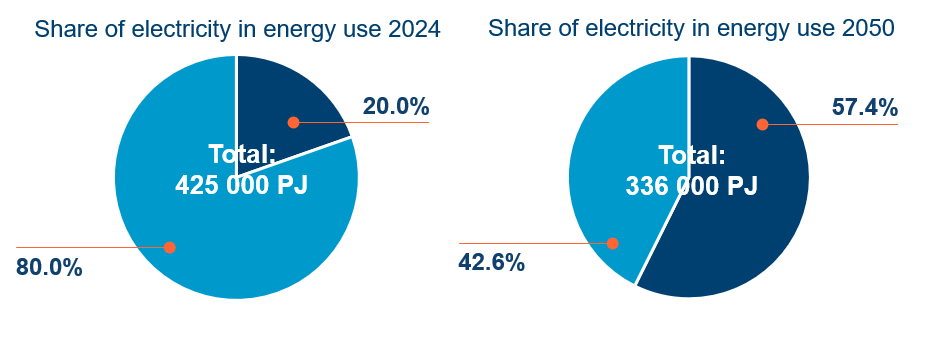 |
Source: Polar Capital estimates as at May 2026. Forecasts contained herein are for illustrative purposes only and does not constitute advice or a recommendation. |
Additionally, carbon-free power is projected to grow sixfold, rising from 36% in 2020 to 90% by 2050.
Electricity generation to increase by 2.5-times, or 3% p.a. (CAGR 2020-2050) |
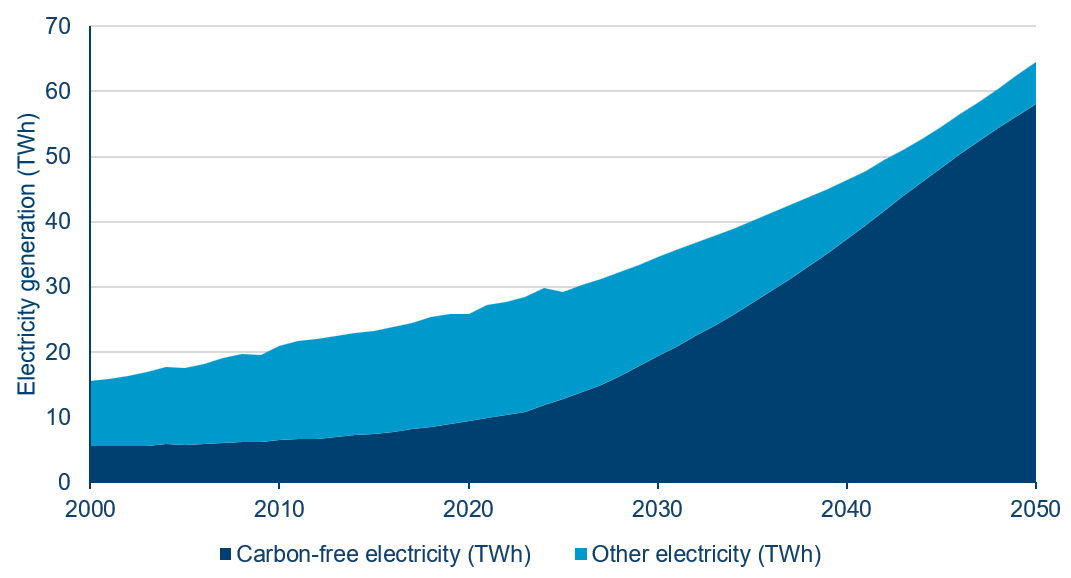 |
Source: Polar Capital estimates as at May 2026; IEA, www.iea.org/reports/key-world-energy-statistics-2020/final-consumption for historical figures (until 2020); BNEF for historical figures. Forecasts contained herein are for illustrative purposes only and does not constitute advice or a recommendation. |
By 2050, 65% of all new electricity demand is expected to be driven by emerging technologies and sectors – specifically data centres, humanoid robots, heat pumps, electric vehicles and green hydrogen production – with the rest stemming from traditional, existing uses of power.
Electricity demand growth from 2020 |
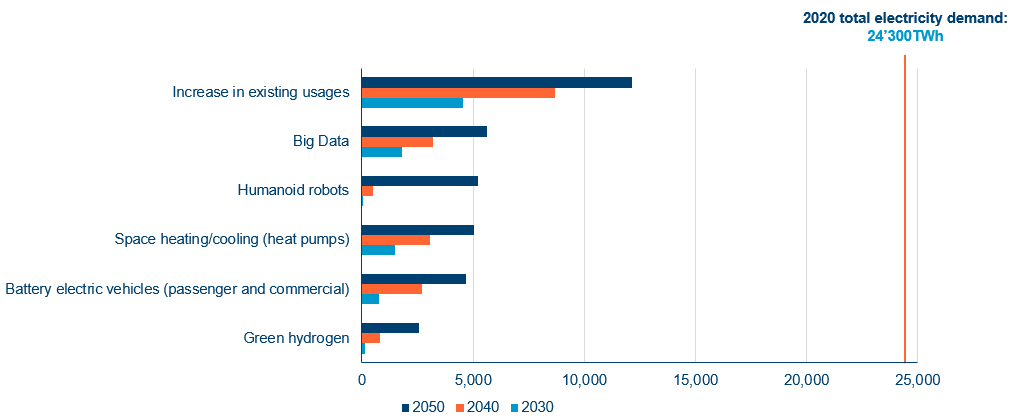 |
Source: Polar Capital estimates as at May 2026; BNEF for historical figures. Forecasts contained herein are for illustrative purposes only and does not constitute advice or a recommendation. |
Massive investments into next-generation solutions
AI data centres will act as the primary catalyst for electricity demand growth through the next five years. To maximise efficiency, data centres will have to adopt advanced architectures. Key steps include transitioning to solid-state transformers and 800V DC rack power supplies, adopting optical interconnects and utilising custom semiconductors for data processing. These new energy efficient designs drive strong demand for power semiconductors, optical components and the underlying cooling and electrical infrastructure.
Driven by rising electricity demand, global spending on power grids and infrastructure is growing rapidly as well. This benefits companies supplying cables, transformers, switchgear, grid stabilisation and automation and software solutions that enable higher penetration of renewables and greater system flexibility.
Stationary battery storage is increasingly critical, not only for renewable integration but also for load balancing and behind-the-meter applications, including data centres.
Physical AI systems, such as humanoid robots, autonomous vehicles, drones and smart machines, will drive substantial future increases in electricity consumption. Balancing sensory capabilities and computational power will be essential to optimise energy efficiency and thereby drive down operational costs.
To capitalise on the global electrification boom, the Polar Capital Smart Energy Strategy targets clean energy value chain leaders across four primary power infrastructure clusters:
- Clean power generation: Companies developing low-carbon, renewable energy sources like wind and solar power, as well as renewable power producers
- Energy transmission and distribution: Infrastructure equipment suppliers and microgrid developers that modernise and expand the electricity grid
- Energy conversion and storage: Suppliers of energy storage systems to secure grid stability as well as power semiconductors that reduce energy conversion losses
- Energy efficiency: Solution providers accelerating efficiency and electrification across buildings, data centres, transport and industrial markets
Looking beyond the current geopolitical situation
The extent to which the geopolitical impasse between the US/Israel and Iran – and its upward pressure on oil prices – will lead to lasting global economic harm remains uncertain.
Regardless of how the Middle East conflict concludes, the global move toward clean electrification will only speed up, reinforcing the strong fundamental outlook for the Polar Capital Smart Energy Strategy’s core holdings.